
Answer: Subnet Design Exercise 2
Today’s post shows the solution to subnet design exercise 2, specifically the IP subnets. This post isn’t all that meaningful without reading the other one first – after that, and after you take a crack at creating the design yourself, dive in!
The figure shows three WAN subnets, which should be allocated from network 172.30.0.0, and three LAN subnets, which should be allocated from network 172.20.0.0. You should think about these networks separately.
Focusing on the LAN subnets, one requirement stated that you should use a single mask throughout the network, so you can ignore the number of hosts per subnet for the smaller requirements, and just pay attention to the largest requirement: 128 hosts/subnet for R3’s LAN subnet.
To support 128 hosts, you need H host bits such that 2^H – 2 => 128. Some quick math tells us that H=7 is too few (2^7 – 2 = 126), but H=8 is enough, because 2^8 – 2 = 254.
The third requirement also told us to use the fewest host bits, so while H=9, H=10, and so on would work, H=8 is the lowest value that meets the requirements. The mask that has 8 host bits is /24, because /24 by definition means 24 prefix bits, leaving 8 more bits to round out the 32 bits in an IPv4 address.
Following the same logic for the mask in network 172.30.0.0 for the WAN subnets, all three WAN subnets require only 2 hosts. To support 2 hosts, you need H host bits such that 2^H – 2 => 2. Some quick math tells us that H=2 is exactly the right answer (2^2 – 2 = 2), with the prefix mask being /30.
The next step is to list all the subnet IDs, or at least enough to see the pattern. I leave the how/why as an exercise, but here’s a partial list for the LAN subnets in network 172.20.0.0:
172.20.0.0
172.20.1.0
172.20.2.0
172.20.3.0
.
.
.
172.20.253.0
172.20.254.0
172.20.255.0
Similarly, for network 172.30.0.0, for the /30 WAN subnets, you should at least list enough of the subnet IDs to see a pattern. I leave the how/why as an exercise (you can always post a question here to ask), but here’s a partial list for the LAN subnets in network 172.30.0.0, mask /30:
172.30.0.0
172.30.0.4
172.30.0.8
172.30.0.12
172.30.0.16
.
.
.
172.30.255.248
172.30.255.252
The exercise requirements state that the WAN subnets should use the numerically lowest subnet IDs from network 172.30.0.0, starting with the R1-R2 link, then the R2-R3 link, and then the R1-R3 link. Without any reason to avoid it, the zero subnet (172.30.0.0) should be used. So, just pick the first three subnets from the list of /30 subnets of network 172.30.0.0.
Similarly, the fourth requirement states that the three numerically highest subnets should be the R1 LAN, R2 LAN, and R3 LAN, in that order. Just pick those from the list from the list.
The final choices for the subnets then are:
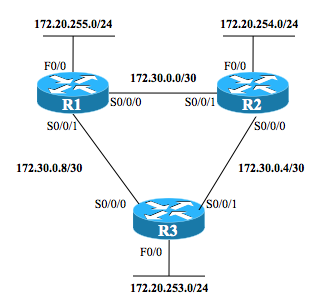
R1-R2 WAN: 172.30.0.0/30
R2-R3 WAN: 172.30.0.4/30
R1-R3 WAN: 172.30.0.8/30
R1 LAN: 172.20.255.0/24
R2 LAN: 172.20.254.0/24
R3 LAN: 172.20.253.0/24